
You’re exhausted, ready for sleep, and then it hits: a sharp, throbbing pain in your tooth that refuses to let you rest. If you’ve ever suffered from a toothache at night, you know how relentless and isolating it can feel. Unlike daytime discomfort, nighttime tooth pain often seems louder, sharper, and impossible to ignore. But this isn’t just in your head. There are real biological reasons why dental pain intensifies after dark. Understanding these factors and knowing what to do can help you find relief and take the right next steps.
This guide explains why tooth pain is worse at night, explores the most common underlying causes, offers practical strategies for immediate comfort, and clarifies when professional care becomes urgent.
Several interconnected physiological changes occur when you lie down and try to sleep, all of which amplify dental pain.
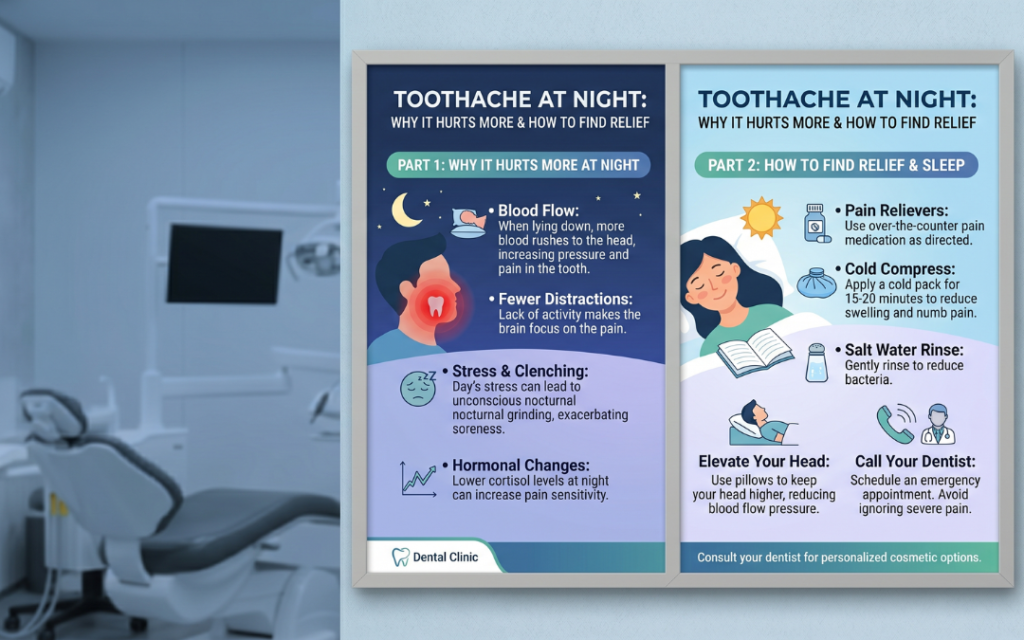
When you’re upright during the day, gravity helps drain blood from your head. But when you lie flat, blood pools slightly in the vessels of your face and jaw. This increases pressure inside the pulp chamber, the innermost part of your tooth that contains nerves and blood vessels. If that pulp is already inflamed due to decay, infection, or trauma, the added pressure triggers more intense pain signals. This is why many people report their toothache worse when lying down, and why sitting up or propping yourself with pillows often brings noticeable relief.
Cortisol, a hormone produced by your adrenal glands, acts as a natural anti-inflammatory agent. Its levels follow a circadian rhythm, peaking in the morning and dropping to their lowest point around midnight. With less cortisol circulating at night, your body’s ability to suppress inflammation weakens. As a result, even mild dental irritation can feel significantly more painful.
During the day, your brain is busy processing sounds, conversations, tasks, and visual stimuli. These distractions help drown out minor pain signals. At night, in a quiet, dark room, your nervous system becomes more attuned to internal sensations. A dull ache that went unnoticed during work can suddenly dominate your awareness when you’re trying to sleep.
Many people unconsciously clench or grind their teeth while sleeping, a condition called bruxism. This places extreme force on teeth, especially those already weakened by cracks, large fillings, or gum recession. The repeated pressure can irritate the ligaments around the tooth root or aggravate an existing nerve problem, causing pain that wakes you up at night. You might also notice jaw soreness or headaches in the morning.
Saliva production naturally decreases during sleep. Saliva helps neutralize acids, wash away food particles, and protect against bacterial growth. A dry mouth creates a more acidic, bacteria-friendly environment, especially around a decaying or infected tooth, which can worsen irritation overnight.
A toothache at night is almost always a sign of an active dental issue. Here’s a detailed look at the most frequent culprits.
This occurs when deep decay, a large filling, or trauma allows bacteria to reach the pulp. The nerve becomes inflamed and hypersensitive. Early on, pain may only happen with hot or cold stimuli. But as inflammation worsens, the nerve starts firing spontaneously, especially at night. The pain is often described as sharp, shooting, or throbbing and may radiate to the ear, jaw, or temple.
An abscess is a pocket of pus caused by a bacterial infection. It can form at the tip of the tooth root (periapical abscess) or in the gums (periodontal abscess). Pressure builds inside the confined space, causing constant, severe pain that intensifies when lying down. Other signs include swelling, fever, bad breath, and a bitter taste. This is a severe toothache at night that requires immediate treatment.
A hairline fracture in a tooth may not be visible on X-rays but can allow bacteria to seep into the dentin or pulp. Pain typically occurs only when biting down or releasing pressure, but at night, grinding or positional shifts can trigger sudden, sharp jolts. The pain may come and go, making diagnosis tricky.
When plaque and tartar build up below the gumline, they destroy the bone and ligaments supporting your teeth. Deep periodontal pockets become infected, leading to dull, aching pain, especially in multiple teeth. Lying down increases pressure in these inflamed areas, worsening discomfort at night.
Your upper back teeth sit directly beneath your maxillary sinuses. When these air-filled cavities become inflamed or filled with mucus (due to a cold, allergies, or infection), the pressure pushes down on the tooth roots. This mimics a toothache, usually in several upper molars, and feels worse when bending over or lying flat. Unlike true dental pain, it’s often accompanied by nasal congestion, postnasal drip, or facial tenderness.
While you wait to see a dentist, follow these evidence-based steps to manage pain safely and effectively.
Sleep with two or three pillows to keep your head above heart level. This reduces blood flow to the head and eases pressure on the affected tooth.
Mix half a teaspoon of table salt in one cup of warm (not hot) water. Swish slowly around the painful area for 30 seconds, then spit. Repeat every two to three hours if needed. Saltwater helps reduce inflammation, cleanse debris, and create an environment less friendly to bacteria.
Place a cold pack or bag of frozen peas wrapped in a thin towel on the outside of your cheek near the painful tooth. Apply for 15 minutes, then remove for 15 minutes. Repeat as needed. Cold constricts blood vessels, numbs nerve endings, and reduces swelling.
Ibuprofen (Advil, Motrin) is ideal because it reduces both pain and inflammation. Acetaminophen (Tylenol) works for pain but doesn’t fight inflammation. Follow package dosing instructions. Never place aspirin or other painkillers directly on your gum. This can cause chemical burns.
Clove oil contains eugenol, a natural antiseptic and mild anesthetic. Dip a cotton ball in a small amount of clove oil and gently press it against the affected tooth for five to ten minutes. Do not swallow. This is not a cure, but it may provide temporary numbing.
Don’t eat or drink anything extremely hot, cold, sweet, or acidic. Avoid chewing on the painful side. Skip alcohol and smoking, as both increase blood flow and delay healing.
These home remedies for toothache at night can help you get through the night, but they are not substitutes for professional care.
Toothache at night? Use this symptom checklist to determine possible causes and decide when you need to see a dentist.
Symptom Pattern | Likely Cause | Immediate Actions | When to See a Dentist |
Severe toothache at night with swelling, fever, or pus | Dental abscess or spreading infection | Elevate head, rinse with salt water, take ibuprofen, apply cold compress | Same day—this is a dental emergency |
Tooth pain wakes me up at night with sharp, electric-like jolts | Irreversible pulpitis or cracked tooth | Avoid pressure on tooth, use OTC pain relief, sleep propped up | Within 24 to 48 hours |
Toothache worse when lying down, improves when sitting up | Pulp inflammation or sinus pressure | Sleep elevated, monitor for nasal symptoms | If pain lasts more than two nights |
Dull, constant ache in multiple upper teeth at night | Sinus infection or gum disease | Use decongestants (if sinus-related), gentle salt rinses | If no improvement in three days or gum bleeding occurs |
Pain only at night, no daytime symptoms | Bruxism or positional nerve irritation | Try stress reduction, avoid caffeine, consider a night guard | At next dental visit, or sooner if pain persists |
This table helps you assess urgency and take appropriate action, but only a dentist can confirm the diagnosis.
Temporary relief won’t fix the problem. To truly resolve a toothache at night, you need treatment based on the underlying cause.
Delaying treatment risks permanent damage, tooth loss, or systemic infection.
Seek immediate care if you experience any of the following:
These signs suggest a toothache at night emergency that could spread to other parts of the body if untreated. Dental infections can become life-threatening if they reach the bloodstream or airway.
Prevention is always less painful and less expensive than emergency treatment.
A toothache at night is more than a nuisance. It’s a warning sign that demands attention. While night time tooth pain relief methods can help you survive the night, only professional dental care can address the root cause and prevent long-term damage. Ignoring the pain may lead to worsening infection, tooth loss, or even hospitalization in rare cases. Don’t assume it will go away. Most dental problems only get worse with time.
If you’re struggling with persistent or severe toothache at night, don’t wait until morning. Contact Orosmyle Dental Clinic for prompt, compassionate emergency care. We offer same-day appointments, gentle treatment, and clear explanations, so you can rest easy knowing your pain will be taken seriously and resolved quickly.
Why is tooth pain worse at night?
Lying down increases blood pressure in the head, cortisol (natural pain relief) drops at night, and there are fewer distractions to mask the pain.
What are the main causes of toothache at night?
Common causes include tooth decay reaching the nerve, dental abscess, cracked teeth, gum disease, or sinus infections.
What can I do for night time tooth pain relief at home?
Elevate your head, rinse with warm salt water, apply a cold compress, take ibuprofen, and avoid triggers like hot or cold foods.
What should I do if tooth pain wakes me up at night?
Stay calm, sit up, rinse gently, take pain medicine, and call a dentist first thing in the morning.
Is a severe toothache at night an emergency?
Yes, especially if you have swelling, fever, difficulty swallowing, or pus. These require immediate dental attention.
Why does my toothache get worse when lying down?
Gravity causes more blood to flow to your head, increasing pressure on an already inflamed or infected tooth.
Are home remedies effective for toothache at night?
They offer temporary relief but do not treat infection or decay. Professional care is always needed for lasting results.
How can I stop tooth pain at night permanently?
See a dentist to treat the cause, such as a cavity, abscess, or cracked tooth, with appropriate procedures like fillings, root canals, or extractions.
Can a toothache at night go away on its own?
Rarely. Most causes involve infection or nerve damage that will not heal without treatment.
When should I seek emergency care for a toothache at night?
Go immediately if you have facial swelling, fever, trouble breathing, or pain that doesn’t improve within 24 to 48 hours.
Book your online appointment easily and at your convenience.Experience professional teeth whitening that is safe and effective.Enjoy a brighter, healthier smile with expert dental care.