
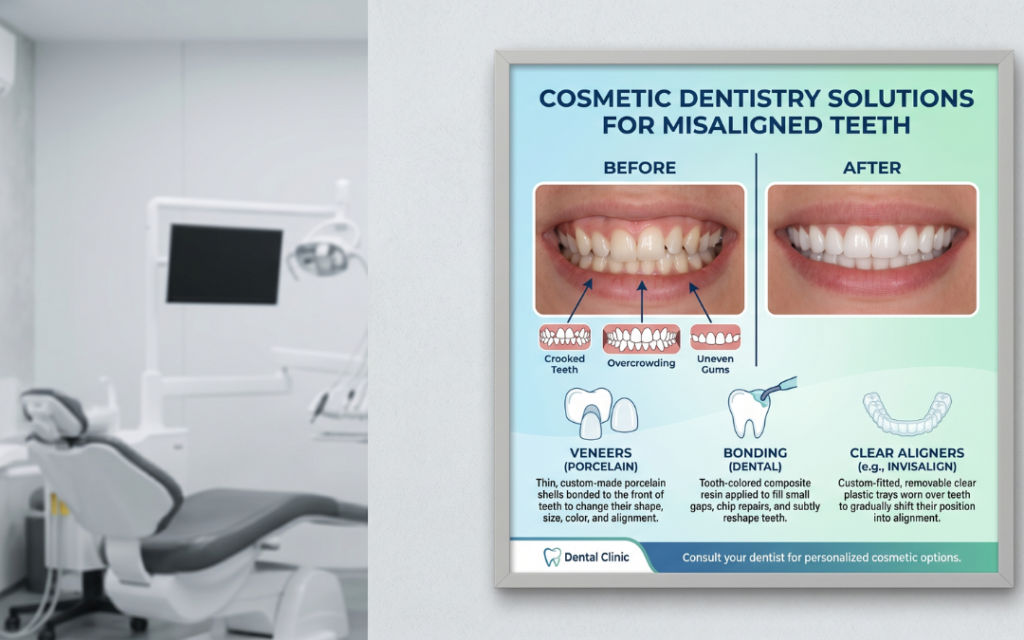
Many adults long for a straighter smile but feel discouraged by the idea of wearing metal braces for months or years. The good news is that modern dentistry offers effective, discreet alternatives. Through cosmetic dentistry for crooked teeth, you can achieve a beautifully aligned-looking smile without traditional orthodontics, often in just a few visits. These solutions don’t physically move your teeth like braces do. Instead, they enhance the visible surfaces to create the illusion of perfect alignment. Whether you have slightly rotated teeth, minor crowding, small gaps, or uneven edges, there’s likely a cosmetic option that fits your needs, budget, and timeline. This guide explains how these treatments work, who they’re best for, and what you can realistically expect.
It’s important to know that cosmetic dentistry focuses on appearance, not function. If your crooked teeth cause pain, difficulty chewing, jaw clicking, or bite problems, orthodontic treatment (like braces or aligners) may still be necessary. However, if your main concern is how your smile looks, not how it functions, cosmetic options can deliver dramatic visual improvements quickly and comfortably. These treatments are ideal for adults who want immediate results without long-term hardware or lifestyle adjustments.
Porcelain veneers are ultra-thin, custom-fabricated shells made from high-quality dental ceramic. They are permanently bonded to the front surface of your natural teeth to change their shape, size, color, and alignment.
How it works:
During the first visit, your dentist removes a very thin layer of enamel (about 0.5 mm) to make room for the veneer. Impressions or digital scans are taken and sent to a dental lab. While you wear temporary veneers, the lab crafts your final set, usually in one to two weeks. At the second visit, the temporaries are removed, and the permanent veneers are checked for fit, shade, and symmetry before being bonded with strong dental cement.
Why it works for crooked teeth:
Even if a tooth is slightly turned inward or overlaps its neighbor, the veneer can be shaped to appear perfectly straight and aligned with the rest of your smile. Gaps can be closed, short teeth lengthened, and uneven edges smoothed, all in one seamless design.
Pros:
Cons:
This is the most popular choice for a full smile makeover for crooked teeth.
Dental bonding uses a tooth-colored composite resin, the same material used for fillings, to reshape and repair teeth directly in the dental chair.
How it works:
No anesthesia is usually needed. Your dentist selects a shade that matches your natural teeth, applies the soft resin to the tooth, sculpts it into the desired shape, and hardens it with a special blue light. The surface is then polished to blend seamlessly with surrounding enamel.
Why it works for crooked teeth:
Bonding can fill small gaps between teeth, build out a narrow tooth to match its neighbors, or cover a slightly rotated tooth by extending its visible surface. It’s especially effective for minor asymmetries in the front six teeth.
Pros:
Cons:
Dental bonding for crooked teeth is perfect for those seeking a fast, low-cost improvement with minimal intervention.
While technically orthodontic, clear aligners like Invisalign are often considered a cosmetic solution because they’re nearly invisible and removable.
How it works:
Using 3D imaging, your dentist creates a step-by-step digital plan to gradually shift your teeth into better alignment. You’ll receive a series of custom plastic trays, each worn for one to two weeks. For mild cases, “cosmetic alignment” focuses only on the front six to eight teeth and can be completed in 6 to 12 months.
Why it works for crooked teeth:
Unlike veneers or bonding, aligners actually move your natural teeth into a straighter position. This means no enamel removal, no artificial materials, and a result that’s both functional and aesthetic.
Pros:
Cons:
This is the best option if you want to straighten teeth without braces while preserving your natural tooth structure.
Also called enamel shaping, this is the least invasive option. It involves gently reshaping minor imperfections in your tooth enamel using fine drills or polishing tools.
How it works:
Your dentist carefully files down small points, sharp edges, or slightly overlapping areas to improve symmetry. Often paired with bonding to fill in adjacent spaces or balance proportions.
Why it works for crooked teeth:
If one tooth is just a millimeter longer or has a rough corner that makes your smile look uneven, contouring can create instant harmony. It’s not for major misalignment, but it’s highly effective for fine-tuning.
Pros:
Cons:
Here’s a detailed comparison of the most effective cosmetic treatments to fix crooked teeth without braces, including what each option is best for, treatment time, durability, and ideal patient goals.
Treatment | Best For | Treatment Time | Durability | Ideal For Patients Who Want |
Veneers for crooked teeth | Moderate crowding, gaps, discoloration, rotated teeth | 2 to 3 visits over 2 to 3 weeks | 10 to 15+ years | A complete, long-lasting smile transformation |
Dental bonding for crooked teeth | Small gaps, minor overlaps, chipped edges | 1 visit (30 to 60 mins) | 3 to 7 years | Fast, affordable, reversible correction |
Clear aligners | Mild to moderate crowding or spacing | 6 to 18 months | Permanent (with retainer) | Actual tooth movement without visible hardware |
Tooth contouring | Slight unevenness, sharp edges, tiny overlaps | 1 short visit | Permanent | Instant, no-cost refinement during a regular check-up |
These invisible solutions for crooked teeth offer flexibility based on your goals, budget, and timeline.
You’re likely a good candidate for cosmetic dentistry for crooked teeth if:
You may need orthodontics instead if you have:
A skilled cosmetic dentist for crooked teeth will evaluate your bite, gum health, and smile goals before recommending a treatment plan.
At your first visit, your dentist will:
This ensures you make an informed decision with realistic expectations.
Unlike braces, these cosmetic dental treatments for crooked teeth focus on the visual impact that matters most in social and professional settings.
Remember, cosmetic dentistry enhances your smile. It doesn’t replace the need for preventive care.
You don’t need braces to love your smile. With today’s cosmetic dentistry for crooked teeth, options like veneers, bonding, clear aligners, and contouring offer smart, stylish ways to correct mild to moderate misalignment, without wires, brackets, or long waits. Whether you want subtle refinement or a dramatic smile makeover for crooked teeth, the right treatment can give you the confidence to smile freely in photos, meetings, and everyday life.
For expert evaluation and personalized care that blends artistry with dental science, visit Orosmyle Dental Clinic. Our team listens to your goals, explains your options clearly, and helps you achieve a naturally beautiful, straight-looking smile, comfortably and efficiently.
Can cosmetic dentistry fix crooked teeth without braces?
Yes, treatments like veneers and bonding can create the appearance of straight teeth without moving them.
Are veneers a good option for crooked teeth?
Yes, veneers for crooked teeth are ideal for masking moderate misalignment and improving overall smile aesthetics.
How does dental bonding fix crooked teeth?
Dental bonding for crooked teeth reshapes and fills gaps using tooth-colored resin to make teeth appear aligned.
Can you really straighten teeth without braces?
Yes, clear aligners actually move teeth, while veneers and bonding create the illusion of straightness.
What are the best invisible solutions for crooked teeth?
Porcelain veneers, dental bonding, and clear aligners are the top discreet options.
How long do cosmetic fixes for crooked teeth last?
Bonding lasts 3 to 7 years; veneers last 10 to 15 years with proper care.
Is a cosmetic dentist for crooked teeth different from an orthodontist?
Yes, a cosmetic dentist focuses on appearance; an orthodontist corrects bite and alignment functionally.
Can tooth contouring fix crooked teeth?
Only for very minor issues like uneven edges or tiny overlaps, not for significant crowding.
What’s involved in a smile makeover for crooked teeth?
It typically combines veneers, whitening, and bonding to create a harmonious, straight-looking smile.
Are there alternatives to braces for crooked teeth?
Yes, veneers, bonding, clear aligners, and contouring are all effective alternatives for mild to moderate cases.
Book your online appointment easily and at your convenience.Experience professional teeth whitening that is safe and effective.Enjoy a brighter, healthier smile with expert dental care.